Is Real-Debrid Dead? The 2026 Debrid Reality Check
The rumors have circulated for months: file-host delistings, cache changes, tighter API rules. Real-Debrid is not dead, but the ground has shifted. Here is the honest breakdown and how to build a setup that survives any single provider outage.
12 min read
If you follow debrid streaming at all, you have seen the headlines. Links disappearing. Cache changes. Legal letters to file hosts. The question comes up weekly in every streaming community: is Real-Debrid dead, and is the golden age of cheap, instant debrid streaming over?
The honest short answer is no. Real-Debrid is not dead. But the ground under it has shifted, and relying on it as your single source now carries real, measurable risk. This article explains what actually changed, which alternatives genuinely work in 2026, and why the right response to the debrid shake-up is not switching providers but diversifying your sources with a player built for failover.
What actually happened to Real-Debrid?
Real-Debrid is still running, still profitable, and still fast. What changed is its scope. Through 2024 and 2025 the service faced heightened copyright enforcement and responded by delisting links to certain restricted file hosts and tightening how third-party apps query its cache. The catalog narrowed. The "universal proxy for everything" reputation it built earlier is what actually died, not the company. You can confirm the service is live on the Real-Debrid official site.
Here is what actually happened, in plain terms. The "is Real-Debrid dead" panic traces back to a series of real, public events rather than one dramatic shutdown.
Legal pressure pushed file-host delistings. Copyright enforcement groups increased their demands, and Real-Debrid responded the way most surviving services do: it pulled links to the file hosts that drew the most heat and tightened the rules around them. The service never published these changes as a single dated changelog, so treat any specific timeline you see online with caution. The practical effect, as of June 2026, was clear regardless of the exact dates: a smaller pool of instantly available links than the service offered eighteen months earlier.
The API got stricter. Real-Debrid tightened how apps check cached status, which broke or slowed some of the older third-party integrations that assumed they could hammer the cache-check endpoint freely. Apps that were not updated to the newer request patterns started reporting more "not cached" results, which fed the perception that the cache itself had collapsed. In many cases the content was still there, but the app asking for it was using an outdated method.
Cache reliability became uneven, not absent. The result is a service that still works exceptionally well for a narrower band of content. Widely cached mainstream movies and current TV episodes still resolve almost instantly, because thousands of users request them and keep them warm in the cache. Niche content, older seasons, foreign releases, and titles from smaller distributors now sit in a gray zone. Sometimes a link is cached and plays at once. Sometimes it is not, and you wait for a seed or hunt for another source.
The honest limitation is that Real-Debrid in 2026 is a less comprehensive catalog than it was at its peak. It is not dead. It is a very fast cache for mainstream content rather than a bottomless library for everything ever uploaded. If your expectations are calibrated to the older reputation, the service will feel broken even though it is working exactly as designed.
Why does Real-Debrid keep saying "not cached" now?
Most "not cached" results in 2026 come from three causes: the file host behind that link was delisted, the title is genuinely niche and nobody has seeded it into the cache recently, or your app is using an outdated cache-check method that the tightened API no longer answers cleanly. The link is not always missing. Often the request is just being asked the wrong way, or for content that was never popular enough to stay warm.
Cached vs uncached, and why it matters. A debrid cache works because popularity creates warmth. When many people request the same release, the file lives in fast storage and streams the instant you press play. A title nobody has touched in months may need to be pulled and processed first, which is the delay you feel when a link sits and spins. This was always how debrid worked. What changed is that the warm band narrowed, so you cross from cached to uncached more often than you used to.
The part most setup guides skip. A single "not cached" result tells you almost nothing about whether the content is available. The same movie that is uncached on one provider may be instantly cached on another, because each provider keeps a different pool warm. Treating a single provider's "not cached" as a final answer is the core mistake, and it is exactly the failure a multi-source player removes. For a deeper look at how caching actually works under the hood, see our What is Debrid overview.
Is Real-Debrid still worth paying for in 2026?
Yes, if your use case matches its current strengths. Real-Debrid remains the fastest and cheapest way to stream widely cached mainstream content, and for popular releases nothing resolves faster. The "set it and forget it, it has everything" era is over, but as one piece of a wider setup it is still one of the best values in streaming. As of June 2026, pricing runs about EUR4 (roughly $4.21) for 30 days and about EUR16 (roughly $16.86) for 180 days, per the provider's own site.
Where Real-Debrid still leads. For current blockbusters, popular streaming releases, and well-seeded torrents, Real-Debrid is hard to beat. The infrastructure is mature, the integrations are everywhere, and the large user base keeps new releases warm within minutes of a good upload appearing. If most of what you watch is in the top of any given week, you will rarely notice the narrowing at all.
Where it falls short. If your viewing leans toward obscure films, older seasons of niche shows, foreign-language catalogs, or content that lived on the file hosts that got delisted, you will hit dead links more often than you used to. You will wait for seeds or go looking for an alternate source. That is not "dead," but it is a real step down from the universal cache Real-Debrid was once known for, and pretending otherwise sets you up for frustration.
Pick Real-Debrid if: speed per dollar is your main metric and you mostly watch popular, widely available content.
Pick a multi-provider approach if: your library regularly reaches outside the top titles of any given week, or you simply do not want one company's policy change to take your whole setup offline.
Real-Debrid alternatives: what actually works in 2026?
The realistic alternatives are TorBox, Premiumize, and AllDebrid. Each covers a useful niche, but none of them is a clean one-to-one replacement for Real-Debrid as a single source, because every provider keeps a different pool of content warm. The strongest setup uses more than one in parallel rather than swapping one single point of failure for another.
The figures below are accurate as of June 2026. Debrid services adjust their tiers periodically, so always confirm the current rate on the provider's own site before subscribing. Where a provider does not publish a clear public rate, we describe it qualitatively rather than guess.
| Provider | Pricing (as of June 2026) | Strengths | Weaknesses |
|---|---|---|---|
| Real-Debrid | ~EUR4 (~$4.21) / 30 days; ~EUR16 (~$16.86) / 180 days | Largest warm cache pool, fast CDN, widest app integration | Narrowing scope, file-host delistings, stricter API |
| TorBox | Free tier; paid from ~$3/mo (Essential) and ~$5/mo (Standard) to ~$10/mo (Pro) | Modern architecture, Usenet support, active development | Smaller cache pool, slower to warm brand-new torrents |
| Premiumize | Varies by plan (confirm current rate on premiumize.me) | Broad file-host support, bundled cloud and VPN-style features | Higher price, European routing can add latency for US users |
| AllDebrid | Varies by plan (confirm current rate on alldebrid.com) | Cheaper entry price, long-standing alternative | Faces the same legal landscape as Real-Debrid, smaller community |
TorBox has become the most common second provider people add alongside Real-Debrid. It is built on newer server architecture and includes Usenet support, which gives it a different content profile than the torrent-focused providers. Its cache pool is smaller, so it can be slower to warm a brand-new torrent, but it frequently has exactly the niche title Real-Debrid is missing. You can read TorBox's own feature breakdown on the TorBox official site.
The pattern across all of these is the same. No single provider is the universal answer anymore. The winning strategy is not picking the perfect one. It is running two or three and letting a player route around whichever one is failing at the moment.
Why is a single debrid provider a single point of failure?
Because when that one provider has an outage, an API change, or a cache policy shift overnight, your entire library goes dark until they fix it. A single debrid account is a single point of failure by definition. You are betting your whole setup on one company's uptime and one company's legal decisions, and you have no fallback when either of those moves against you. Spreading across providers is the standard way to remove that risk.
This is the part most setup guides skip. They walk you through adding one debrid key and stop there, as if reliability were solved. It is not. The 2024 to 2025 file-host delistings are the perfect example: a policy decision you had no control over quietly shrank what your single provider could serve, and there was nothing on your end to absorb the loss.
Multi-link aggregation exists because sources break. As of 2026, MIRA Player is the only major Android TV player with built-in multi-link auto-failover across multiple debrid providers. The honest competitor picture matters here. Stremio connects to debrid services through addons and has a large, capable community (per Stremio's reporting, more than 20 million users in 2026), but it lacks native multi-provider failover: if a Real-Debrid link fails mid-stream, you generally drop back to the source list and pick another yourself. TiviMate is an excellent pure IPTV player and one of the best at what it does, but it has no native debrid integration at all. Kodi is endlessly flexible through addons, but reliable cache-level auto-failover across providers is not something it does out of the box and usually involves fragile manual configuration.
MIRA Player treats your linked providers as one redundant pool instead of separate silos. If a stream from Real-Debrid fails, it rotates to your TorBox links. If a TorBox source is slow or uncached, it tries the next ranked source from your pool. You get the speed of whichever cache is warmest with the redundancy of having more than one backend. The provider stops being your single point of failure because no single provider is carrying the whole setup alone.
How does MIRA Player handle multiple debrid sources?
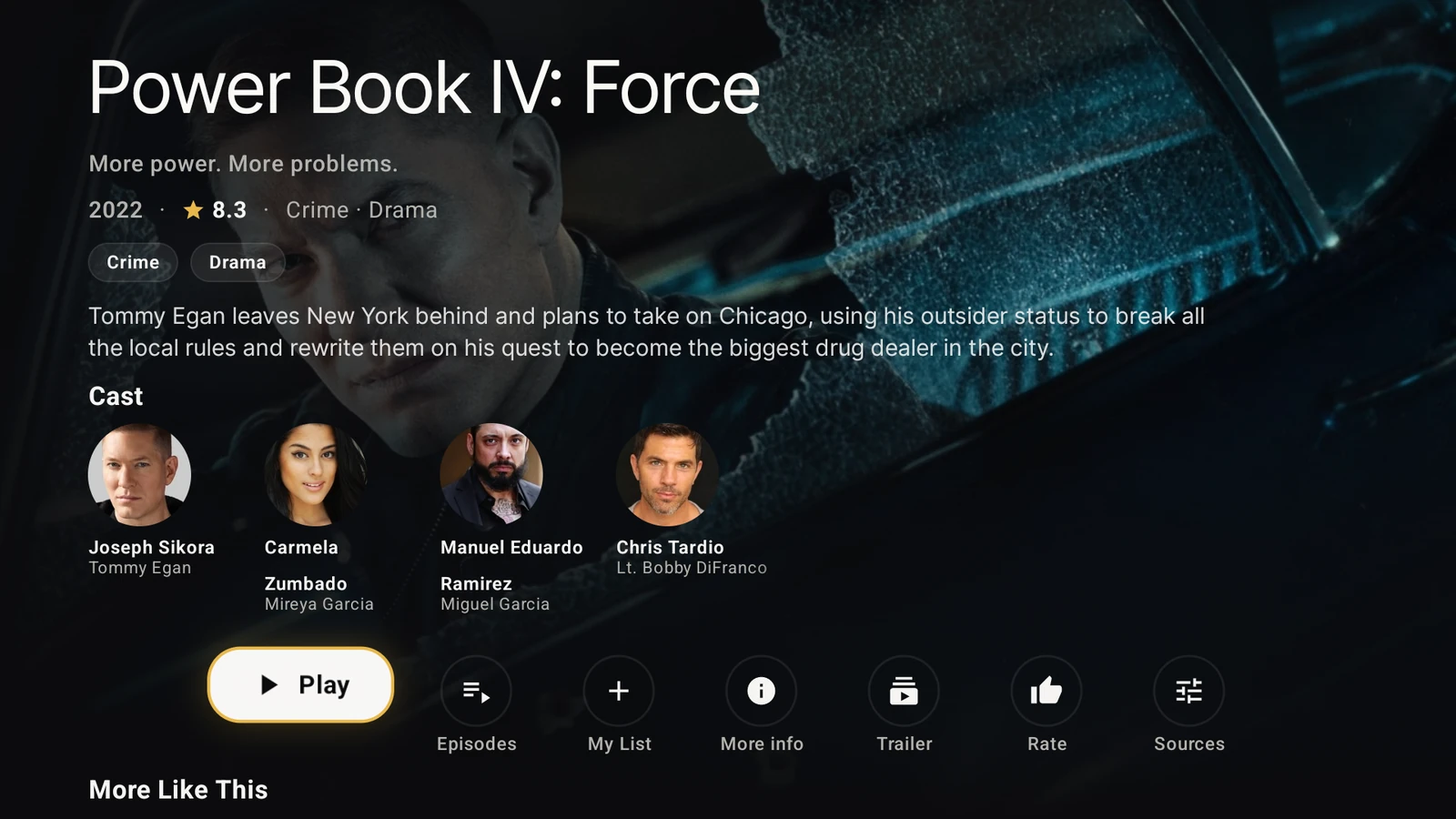
You add your personal debrid API keys once in the player settings, and MIRA Player groups everything available across those accounts into a single unified library. When you press play it ranks every available source and picks the best viable one, then silently rotates to the next ranked source if that stream fails. There is no per-title configuration and no app switching. You set it up once and the routing happens on its own. Your credentials (playlist URLs, Xtream logins, and debrid keys) are stored encrypted, not harvested. MIRA Player runs as a clean, signed Android TV app, consistent with the platform model described in the Android TV docs.
One library from many providers. Your Real-Debrid, TorBox, and Premiumize sources show up together, grouped by title rather than scattered across separate apps. You are not mentally tracking which provider has which movie. You open the title and MIRA Player already knows every backend that can serve it.
Ranked quality auto-pick. When you select something, MIRA Player checks your linked providers and ranks every available stream by resolution, codec and container (a REMUX versus a re-transcoded copy), and caching status. It plays the best viable source automatically instead of making you read through a raw list of links and guess which one is good.
Auto-failover on failure. Here is what actually happens when a stream dies. If a source hits a timeout, returns a 403 or 503, or freezes on a stuck frame, MIRA Player detects the failure and rotates to the next best source from your pool in the background, without a trip back to the menu. To be precise about the claim: failover does not stop the first failure from happening. It absorbs that failure so a dead link becomes a brief reroute instead of a "stream unavailable" wall. You do not touch the remote and you do not open a different app.
This is how you make debrid dependable again in 2026. You stop betting everything on one provider's uptime and policy decisions, and you start running a small portfolio of sources behind a player that understands ranking and rotation. For the technical breakdown of how the source-selection and failover engine works, see our IPTV auto-failover guide, and for where this fits into a full setup, the cord cutting guide.
Frequently asked questions
Is Real-Debrid shutting down?
No. Real-Debrid has not announced a shutdown and remains operational. The "dead" narrative comes from service changes and legal pressure that narrowed its catalog, not from the company closing. It still resolves popular, widely cached content very quickly.
Why does Real-Debrid say "not cached" so often now?
Three causes account for most of it: the file host behind the link was delisted, the title is niche and nobody has kept it warm in the cache, or your app uses an outdated cache-check method the tightened API no longer answers cleanly. A single "not cached" result does not mean the content is unavailable everywhere. Another provider may have it cached.
Can I use Real-Debrid and TorBox together in one player?
Yes, in a player that supports native multi-debrid aggregation. MIRA Player connects to multiple debrid accounts at once and fails over between them automatically. Many other players require addon configurations that do not rotate cleanly between providers when a link fails.
What is the best Real-Debrid alternative in 2026?
There is no single best replacement, because each provider keeps a different pool of content warm. TorBox is the most common second provider people add alongside Real-Debrid thanks to its modern architecture and Usenet support. The most reliable approach is running two or three providers in parallel rather than swapping one single point of failure for another.
Is debrid streaming legal?
Debrid services are file-access and caching tools. Their legality varies by jurisdiction and depends entirely on the content you access through them. MIRA Player is a neutral player that connects to the sources you configure, and you are responsible for ensuring those sources comply with local copyright law. The EFF digital rights resources cover digital consumer rights in depth.
What happens to my watchlist if I add or switch providers?
Your MIRA Player watchlist is stored securely and tied to your profile, separate from any debrid provider's native history. When you add a provider, MIRA Player scans the newly available content and matches it against your existing watchlist, so you keep your saved titles when you add or change a debrid backend.
Stop betting on a single provider. Build a debrid setup that survives any outage.
Get MIRA Player — $20/year